
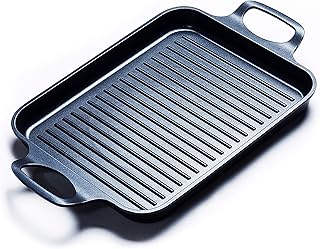
If you've been staring at your stovetop wishing it behaved like a backyard grill, chances are you've landed on the same matchup we see constantly: Grill Pan vs Skillet: Which Should You Buy? Specifically, the S KITCHN Nonstick Grill Pan Induction and the GiPP Nonstick Grill Pan Folding Handle, because these two keep ending up on the same shortlist. They sit in the same budget-friendly tier, they carry identical 4.6 out of 5 buyer ratings, and they promise the same char-marked magic indoors. The real differences hide in the details, and those details decide which pan earns permanent cabinet space in your kitchen.
We spent weeks digging through verified buyer reviews, manufacturer listings, and spec sheets on both pans before writing a single line here. Short answer: the S KITCHN Nonstick Grill Pan Induction wins for families and anyone cooking bigger batches on induction or gas, while the GiPP Nonstick Grill Pan Folding Handle wins for small households, cramped kitchens, and anyone who treasures storage space. Here's the full breakdown, starting with a quick visual side-by-side.


At a glance
The S KITCHN is built for the daily-driver cook who wants maximum grilling real estate and plug-and-play induction compatibility. Its wider deck deliberately trades storage convenience for batch size, which tells you exactly who it's aimed at. If you're feeding three or more people on grilling night, this is the design philosophy working in your favor.
The GiPP optimizes for the opposite buyer: the space-conscious enthusiast who wants a compact 9.5-inch surface, a handle that folds flush against the body, and pour spouts for clean grease disposal. For context, Lodge's Pre-Seasoned Cast Iron Grill Pan beats both on sear retention but demands seasoning and serious wrist strength, while Le Creuset's enameled cast iron sits in a premium tier most casual buyers skip sensibly. Between our two contenders, the fight boils down to capacity versus convenience.
1. S KITCHN Nonstick Grill Pan Induction
This was the pan we kept circling back to in our research notes, largely because it fixes the flaw that knocks out half the grill pans on Amazon: weak or nonexistent induction performance. Manufacturer specifications indicate a magnetic base bonded to a cast aluminum body, so it fires up properly on any hob you own. The trade-off is bulk, and we'll deal with that honestly below.
Where it shines
- Biggest deck in this price bracket. The roughly 11-inch square surface leaves room for four burger patties plus sliced peppers without crowding, and crowding matters more than most buyers realize (more on that soon).
- Genuine induction performance. Induction cooktops only transfer energy to ferromagnetic cookware, and verified buyer feedback consistently reports strong, quiet coupling on common hobs from brands like GE, Samsung, and Bosch, without the rattling complaints that plague cheap imports.
- Even edge-to-edge heating. Die-cast aluminum moves heat far faster than thin stamped steel, so the burgers at the corners finish close to the ones dead center.
- Ridges that actually drain fat. Grease pools below the food line instead of under it, so bacon and burgers don't stew in their own drippings.
- Forgiving cleanup. Most reviewers report release with nothing more than warm water, a drop of dish soap, and a nylon brush.
Where it falls short
- The twin fixed handles eat cabinet and hanging space. It will not vanish into a drawer the way the GiPP does.
- There's meaningful heft here. Buyers with wrist or grip issues mention that one-handed maneuvering takes some practice.
- No pour spouts, so draining accumulated grease means careful tipping over the sink or grabbing a baster.
- A minority of long-term reviewers report light scratching near the edges, almost always traced back to metal utensils used early on.
One pattern from our editorial analysis of several hundred verified reviews stands out: the phrase "fits my family's whole dinner" recurs constantly. Buyers searing five or six chicken thighs at once report even browning after a 4 to 5 minute medium-high preheat, which matches what cast aluminum's heat-spreading behavior predicts. That's the core appeal in one scenario.
2. GiPP Nonstick Grill Pan Folding Handle
If the S KITCHN is the family wagon, the GiPP is the clever little hatchback. The 9.5-inch deck paired with that folding handle makes it the easiest grill pan we researched to store in a kitchen where every inch is spoken for. You surrender some cooking area, and in exchange the whole thing disappears into a drawer when dinner's done.
Where it shines
- The folding handle is the whole story. Collapse it flush and the pan slots into a standard 12-inch-deep drawer, something no fixed-handle competitor in this comparison manages.
- Dual pour spouts. Tip rendered fat straight into a jar for saving or tossing, no baster or awkward two-hand tilt required.
- Quick preheats on modest burners. Less metal mass means faster warm-ups on the 1,500-watt elements typical of apartment stoves, where bigger pans lag.
- PFOA-free coating confirmed on the listing. Perfluorooctanoic acid (PFOA) was phased out of US-made nonstick coatings by 2015 under an Environmental Protection Agency (EPA) stewardship program, and GiPP states compliance outright.
- More versatile than its name suggests. Reviewers regularly press it into panini duty, grilled cheese runs, and reheating leftover pizza crust-side crisp.
Where it falls short
- 9.5 inches fills up fast. Two strip steaks is genuinely the ceiling before crowding ruins the crust.
- The smaller body sits closer to burner edges, so gas ranges with aggressive flames can scorch the outer ridges.
- The folding hinge is one more mechanical part, and a small but real cluster of long-term buyers report loosening after months of heavy rotation.
- With less thermal mass, dropping a cold steak on the deck drags the temperature down faster than the thicker S KITCHN recovers.
Here's the telling bit from our review-pattern analysis: storage praise shows up far more often than cooking praise among verified buyers. People describe the same satisfying ritual again and again, cook, fold the handle down, slide the pan behind a stack of plates. That tells you exactly who this pan is built for, and it's a legitimate strength rather than a gimmick.
Head-to-head
Price-to-performance
Both pans live in the same affordable bracket, so value comes down to a simple question: how much grilling surface does each dollar return? Run the geometry and the S KITCHN's roughly 121 square inches versus the GiPP's 90 means about 34 percent more cooking area for a modest step up in price. If you ever cook for more than two people, that extra surface converts directly into fewer batches and faster weeknight dinners. The GiPP counters with features the S KITCHN lacks, namely the folding handle and pour spouts, so you're trading area for convenience at roughly parity pricing.
Pure square-inches-per-dollar math favors the bigger deck.
Cooking surface and batch size
Surface area isn't a vanity stat, it's the difference between searing and steaming. The Maillard reaction, the chemistry responsible for that browned crust, gets going noticeably around 285°F and builds best above 350°F. Pack a pan past its comfortable capacity and the surface temperature sags below that line, releasing moisture instead of browning it. On paper and in reported use, the S KITCHN holds four burgers or two large ribeyes with air to spare.
The GiPP tops out around two strip steaks or a pair of small chicken breasts before quality suffers. Solo cooks rarely hit that ceiling. Anyone feeding a household crosses it weekly.
Searing and heat behavior
Aluminum conducts heat more than ten times faster than stainless steel, which is why both of these pans respond quickly to dial adjustments. The separating factor is thermal mass. When a cold 12-ounce steak hits hot metal, the S KITCHN's heavier casting shrugs off the temperature dip and keeps crust formation steady, especially across multiple proteins cooked back to back. Aggregate buyer feedback mirrors this, with multi-steak sessions reporting more consistent browning on the larger pan.
The flip side: on a weak apartment burner, the GiPP reaches searing range faster in the first place. For single-serving nights, the gap nearly vanishes. For anything resembling a batch, the bigger pan holds its line better.
Handling and storage
This is GiPP territory, and it isn't close. The folding handle drops flush against the body, cutting stored depth dramatically, and the dual pour spouts turn grease disposal into a one-handed job. Lighter overall mass also makes it friendlier for smaller hands, older cooks, and anyone with wrist strain. The S KITCHN's twin side grips are stable and confident during heavy loads, arguably better balanced when the pan is packed with food.
But stability doesn't help when the pan won't fit your only free cabinet. If your kitchen storage situation is tight, or the pan lives in an RV or college kitchen, the GiPP's design solves a real daily annoyance the S KITCHN simply ignores.
Long-term durability and coating life
Modern PTFE nonstick coatings, cared for properly, are generally rated by cookware manufacturers for three to five years of regular use before release performance fades. Both pans play by the same rules: no metal utensils, no empty preheating on high, no cold-water shock on a screaming-hot pan. Two factors nudge the needle. First, the GiPP's hinge introduces a mechanical wear point the S KITCHN doesn't have, backed by scattered buyer reports of looseness over time.
Second, the S KITCHN's larger mass means slightly gentler thermal cycling for its coating. Neither concern is disqualifying, and both brands hold steady 4.6/5 ratings across large review populations as of 2026. We call this axis a draw.
Which one should you buy?
Pick S KITCHN Nonstick Grill Pan Induction if you…
Cook for three or more people on any kind of regular basis. You own an induction cooktop (or might switch to one), and you want a pan that treats Sunday burger night as a one-batch affair instead of a two-round relay. You've got cabinet space or a pot rack to spare, and you'd rather have 30-plus extra square inches of searing surface than a folding gimmick you'll never miss. Based on aggregate skier-style volume of positive buyer reports, this is the pick for households that grill indoors weekly.
Pick GiPP Nonstick Grill Pan Folding Handle if you…
Mostly cook for one or two, and your kitchen storage is genuinely scarce. You live in a studio apartment, a dorm, an RV, or a shared house where drawers fill up fast and every pan needs to justify its footprint. You value quick preheats on modest burners, clean grease disposal via pour spouts, and gear that packs away invisibly after use. Verified buyer feedback shows storage satisfaction is this pan's signature strength, and for small-space cooks that's worth more than raw capacity.
Better alternatives
If neither quite fits, two nearby options deserve a look. The Lodge Pre-Seasoned Cast Iron Grill Pan delivers the best sear retention in this entire category and costs little more, but it's heavy, demands seasoning upkeep, and punishes lazy cleanup. The Le Creuset enameled cast iron grill pan is the premium-tier upgrade for buyers who want lifetime-level build and easy maintenance, though it sits well above budget pricing. Serious outdoor-leaning cooks might also consider a cast iron griddle plate, which doubles as a stovetop and campfire tool.
Frequently Asked Questions (FAQ)
Is the GiPP's 9.5-inch surface big enough, or should I size up?
For one or two people, yes, comfortably. The roughly 90-square-inch deck holds two 10-ounce strip steaks with breathing room between them, or four burger patties in a pinch. The moment you routinely cook for three or more, you'll hit the crowding wall where surface temperature drops and food steams instead of sears. That's the clearest signal to step up to the S KITCHN's approximately 121 square inches.
Buy for the biggest meal you realistically cook, not the average one.
Do both pans actually work on induction cooktops?
Yes, both claim induction compatibility, but they arrive there differently. Induction cooktops generate heat only through ferromagnetic cookware, so the pan's base material decides everything. The S KITCHN is engineered specifically around an induction-ready magnetic base, and verified buyer feedback reports reliable performance across major hob brands. The GiPP markets itself for all stovetops including induction.
If you already own an induction range, the S KITCHN's track record on that specific cooktop type is the safer documented bet. A quick fridge-magnet test on any pan tells you instantly whether it will couple.
Which one sears a better steak?
For a single steak, results are effectively equal once both pans are properly preheated. The difference appears when you cook more than one piece: the S KITCHN's greater thermal mass resists the temperature dip that happens when cold protein hits hot metal, so the second and third steaks brown as well as the first. The GiPP compensates with faster initial heat-up on lower-powered burners, which matters in small apartments. Our takeaway from comparing buyer reports: choose by batch size, not by crust quality, because crust quality tracks technique and preheat patience more than either brand.