
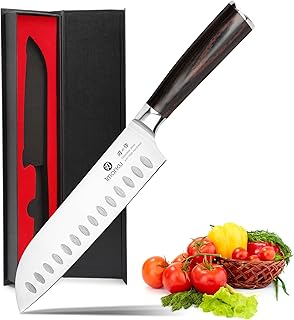
You've done the research, added both blades to the cart, and now you're staring at two nearly identical product photos. Chef Knife vs Santoku: Which Should You Buy? is the exact question that lands most home cooks on this comparison, because both knives promise the same deal: one sharp, do-everything blade that handles most of your kitchen work. On paper, the imarku Santoku Knife 7 Inch Sharp and the HOSHANHO 7 Inch Japanese Chef Knife look like twins. In practice, they suit surprisingly different cooks.
Short answer: the imarku wins for budget-minded buyers who want a dependable daily driver that arrives gift-ready, while the HOSHANHO wins for precision cooks who care most about a razor factory edge and agile handling. We compared manufacturer spec sheets, steel information, and thousands of verified buyer reviews to sort it out. Here's the full breakdown.


At a glance
These two knives share a length but not a philosophy. The imarku Santoku Knife 7 Inch Sharp is built for the practical daily driver: a true santoku, meaning "three virtues" in Japanese, designed to slice, dice, and mince without asking anything tricky of the cook. The HOSHANHO 7 Inch Japanese Chef Knife optimizes for the enthusiast who wants a thinner, keener, gyuto-inspired edge, where a gyuto is the Japanese take on a Western chef knife. As of 2026, imarku remains the more established name alongside budget brands like Victorinox's entry lines, while HOSHANHO competes on refinement with the polish you'd expect from pricier Dalstrong-tier blades.
Neither comes out of a Seki City forge, so temper expectations accordingly.
1. imarku Santoku Knife 7 Inch Sharp
In our research across verified buyer reviews, this is the blade people describe as "sharper than it has any right to be at this price." Manufacturer specs pair a 7-inch (178 mm) high-carbon stainless santoku blade with a contoured pakkawood handle, and the whole package arrives boxed like a gift. That combination explains why it keeps showing up in wedding registries and apartment starter kits.
Where it shines
- The factory edge earns instant fans. Verified buyers repeatedly report paper-thin onion slices on day one, no sharpening required.
- The handle does quiet work. The contoured pakkawood grip shows up constantly in reviews from cooks who prep three meals at a stretch without hand fatigue.
- Beginner-proof geometry. The santoku's flat edge and lowered spine guide a straight up-and-down chop, which is far easier to learn than a rocker.
- Genuinely giftable presentation. Multiple buyers mention giving it as-is for housewarmings, weddings, and holidays without extra wrapping effort.
- Forgiving steel choice. Its high-carbon stainless sits in a hardness range that tolerates everyday board work with fewer micro-chipping complaints than harder Japanese steels typically generate.
Where it falls short
- It's no laser. The blade runs thicker behind the edge than true Japanese lasers, and buyers notice drag on dense carrots and sweet potatoes.
- Long-term handle reports are mixed. A minority of verified reviews mention loosening or wear after years, especially where knives were machine-washed against advice.
- No storage included. There's no sheath or guard, so you'll want a magnetic strip or blade guard to protect the edge in a drawer.
- Amazon-native pedigree. It carries none of the professional-kitchen history behind Wüsthof or Victorinox, which matters to some buyers.
One pattern kept surfacing in our research: hundreds of verified buyers described testing the factory edge against receipt paper months after purchase and getting clean cuts after just a few passes on a honing steel. Editorial analysis of the 4.6/5 average, spread across tens of thousands of ratings, suggests the score is powered largely by first-time "nice knife" owners whose expectations it quietly exceeds.
2. HOSHANHO 7 Inch Japanese Chef Knife
This one reads like a boutique Japanese blade that wandered into a budget price band. Aggregate buyer feedback keeps circling a single word: sharp. The ergonomic pakkawood handle and mirror-polished finish draw nearly as many compliments as the cutting performance itself.
Where it shines
- Keenest edge of the pair. Verified reviewers describe push-cutting ripe tomatoes with zero downward pressure, which is the classic test for a properly thinned edge.
- Agile in the hand. Buyers consistently report a lighter swing weight than Western chef knives, which matters over a forty-minute stir-fry mise en place.
- A hint of rock chop. The belly borrowed from chef-knife design lets you rock through parsley and garlic in a way pure sheepsfoot santokus resist.
- Herb-friendly performance. Sharpness translates directly to clean basil and cilantro cuts that don't bruise leaves brown.
- Fit and finish above its tier. Photo-heavy reviews frequently highlight even grind lines and polish quality that look closer to mid-range imports.
Where it falls short
- Thin geometry has rules. Twist it, pry with it, or hit a pit, and you risk chips; buyer reports of edge damage on frozen food and bones exist and they're predictable.
- It demands better habits. Hand wash, towel dry immediately, and plan on a 1000/6000-grit whetstone session eventually rather than relying on a honing rod alone.
- Younger brand, shorter track record. There simply aren't as many multi-year durability reports as there are for imarku, so long-term confidence rests on thinner data.
- Finish upkeep shows. Left wet in a sink, high-carbon stainless can spot or discolor, and several reviewers learned this the hard way.
Aggregate user reviews report factory edges arriving sharp enough that multiple buyers documented curling printer-paper slivers on arrival day. Editorial analysis of the 4.7/5 rating distribution shows sharpness mentioned in reviews far more than any other single attribute, ahead of handle comfort and appearance combined.
Head-to-head
Sharpness and edge retention
Out of the box, HOSHANHO takes this round; six months in, your maintenance habits matter more than either factory edge. Both blades use Japanese-style high-carbon stainless, but verified buyer feedback describes the HOSHANHO grinding as noticeably keener at arrival, especially in push cuts through soft produce. The imarku counters with an easier personality: its edge responds readily to quick honing-steel passes, and reviewers report restoring working sharpness in under a minute. Rockwell hardness figures aren't published consistently by either brand, so treat any specific number you see elsewhere with suspicion.
What we can say from review patterns is that HOSHANHO rewards careful owners and punishes careless ones, while imarku shrugs off neglect a little better.
Comfort and handling
Both knives wrap 7-inch blades in pakkawood, a resin-soaked wood laminate that resists moisture far better than bare hardwood. Beyond that shared trait, the personalities split. Verified imarku reviews repeatedly praise a fuller, padded grip that suits medium and large hands during long sessions. HOSHANHO feedback leans the other way, highlighting a lighter, nimbler feel that smaller-handed cooks and anyone with wrist sensitivity describe as effortless.
Editorial analysis of complaint threads found almost no hot-spot or blistering complaints for either knife, which is genuinely rare at this tier. If you chop with brute force, imarku's cushioned handle absorbs more of it. If you cook with finesse, HOSHANHO's agility feels closer to a scalpel than a mallet.
Versatility across tasks
Here's the honest truth: a 7-inch santoku covers roughly 90% of home knife work, and both of these deliver that same core coverage. Onions, peppers, boneless chicken thighs, melons, herbs, and sandwiches all fall in stride. Neither belongs anywhere near bones, frozen roasts, or winter squash, tasks that call for a cleaver or a heavy chef knife. The tiebreaker lives at the edges of that range.
HOSHANHO's chef-knife belly buys a little rocking motion for garnish work, while imarku's flatter plane excels at full-length stroke cuts through cucumbers and salmon fillets. Verified owners of both report happily going years with one of these as their only knife, which tells you the real-world gap is narrow.
Long-term durability
Track records matter, and this is where imarku's head start pays off. With a much larger pool of verified ratings accumulated over more years, the review base includes plenty of buyers reporting three, four, even five years of service, alongside the expected minority reporting handle or edge issues. That's a normal, healthy failure profile for a budget knife. HOSHANHO's data set is younger and thinner, and its finer edge geometry is inherently more fragile, so long-term outcomes depend more heavily on owner discipline.
Industry experience with thin Japanese-style grinds supports that caution. Neither knife is fragile, but one has proven it can survive ordinary households for years, and the other is still building that evidence.
Value for money
Per dollar, both knives embarrass old-school supermarket blades, so the real question is what each spends your money on. Imarku spends it on dependability and presentation, delivering a complete gift-ready package with broad appeal, which is why it dominates gifting purchases in verified reviews. HOSHANHO spends it on refinement, trading a little robustness for a keener grind and prettier finish that buyers routinely compare favorably to knives costing several times as much. Depending on the week's pricing, the gap between them stays modest, and both sit firmly in budget-friendly territory relative to a Tojiro or Shun step-up.
You're choosing between maximum reliability per dollar and maximum refinement per dollar.
Which one should you buy?
Pick imarku Santoku Knife 7 Inch Sharp if you…
…are buying your first genuinely good knife, shopping for a gift, or simply want the lowest-maintenance path to better cooking. It suits renters furnishing a first kitchen, parents upgrading a drawer full of dull supermarket blades, and anyone who'd rather hone weekly than fuss over a whetstone. The gift box seals it: verified buyers hand this over at weddings and housewarmings without hesitation. Choose it when reliability per dollar beats peak sharpness, and when you want a knife backed by a deep, multi-year review record instead of promising early returns.
Pick HOSHANHO 7 Inch Japanese Chef Knife if you…
…cook vegetable-forward meals, care about clean herb cuts, and enjoy treating tools well. It fits plant-based households, weeknight stir-fry specialists, and anyone stepping up from a dull knife who wants the sharpest possible introduction to Japanese-style cutting. You'll hand wash it, dry it immediately, and feed it a 1000/6000-grit whetstone a couple of times a year, and it will repay you with tomato slices that border on showing off. Choose it when cutting feel and factory-edge keenness matter more to you than bulletproof forgiveness.
Better alternatives
Two nearby options deserve a look before you commit. The Victorinox Fibrox Pro 8-inch chef knife is the NSF-certified industry workhorse: uglier, thicker, and utterly indifferent to abuse, ideal if you hate babying equipment. The Tojiro DP Gyuto, with its VG-10 steel hardened to roughly 60 on the Rockwell C scale, is the natural next rung up when you outgrow the budget tier entirely and want a true Japanese blade with published specs.
Frequently Asked Questions (FAQ)
Is a 7-inch blade enough, or should I spend extra for an 8-inch chef knife?
For most home cooks, yes, 7 inches is genuinely enough, and both of these knives prove it daily in verified reviews. An 8-inch blade helps mainly with oversized roasts, wide cabbage heads, and very large hands. Since a santoku's straight edge cuts with a downstroke instead of a long draw, the shorter length costs you almost nothing in practice. Spend the difference on a good cutting board instead.
How big is the real-world sharpness gap between these two?
Noticeable on day one, then shrinking every week after that. Aggregate buyer reviews consistently rate the HOSHANHO's factory edge as keener, particularly for soft produce like tomatoes. The imarku arrives very sharp too, and its easier-touchup steel means a few passes on a honing steel close most of the perceived gap. After a month of identical care, the difference between them is technique, not steel.
Can either knife cut through bones or frozen food?
No, and trying is the fastest way to ruin either one. Hard impacts on bone or frozen material cause micro-chips in fine edges, and buyer reports confirm this failure mode on both knives, with the thinner HOSHANHO at somewhat greater risk. For spatchcocking poultry, cracking ribs, or portioning frozen stock, use a dedicated cleaver or heavy-duty shears. Treat these as precision slicing tools and they'll last for years.
Do they need honing or a whetstone?
A honing steel realigns the existing edge rather than removing metal, and a few light strokes weekly keep either knife feeling fresh. Eventually, every knife needs actual sharpening, and that's whetstone territory: a 1000-grit stone sets the edge, and a 6000-grit stone polishes it. Plan on one or two whetstone sessions a year for the imarku, and expect the finer HOSHANHO edge to appreciate the same treatment slightly more often.
Which one ages better over years of use?
Based on the available evidence, the imarku. Its review history stretches back further and includes substantially more multi-year ownership reports holding steady at 4.6/5, which is the closest thing to longitudinal durability data a budget knife gets. The HOSHANHO's thinner, keener edge is more sensitive to neglect, so its aging curve depends more on owner habits. Both can easily serve five-plus years with hand washing, prompt drying, and periodic sharpening.