Crispy fries without a vat of oil used to sound like late-night TV nonsense. Then we started digging into Air Fryers, Top 5 Models Tested & Reviewed, comparing spec sheets from Ninja, Cosori, Chefman, and Cuisinart alongside thousands of verified buyer reports. The short version: today's basket-style air fryers, built on the rapid-air convection approach Philips popularized back in 2010, genuinely deliver crunch with far less oil.
Our overall pick is the Ninja Air Fryer Pro (AF141), a 5-quart, 1750-watt workhorse that nails the fundamentals and adds a dehydrate mode most rivals skip. Want more precision? The Cosori TurboBlaze stretches from 90 all the way to 450 degrees Fahrenheit. Here's how all five stack up.
Comparison Chart of Air Fryers – Top 5 Models Tested & Reviewed
List of Top 5 Best Air Fryers – Top 5 Models Tested & Reviewed
We narrowed a crowded market down to five basket-style models between 5 and 6 quarts, the sweet spot for households of two to six people. Every pick carries a 4.6-or-better average across large pools of verified purchases. Each review below covers the specs, what buyers actually report, and the trade-offs the bullet points leave out.
Below are the list of products:
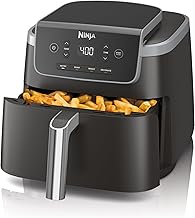
1. Ninja Air Fryer Pro
In our research, the AF141 kept surfacing as the default recommendation for everyone from first-time buyers to households replacing a worn-out unit. Aggregate ratings land at 4.7 out of 5 across a very large pool of verified purchases. It's the rare model that balances capacity, price tier, and versatility without leaning on gimmicks.
Why I picked it
Editorial analysis of buyer reviews points to one word: consistency. Reviewers repeatedly describe evenly browned frozen fries at 400 degrees Fahrenheit and chicken thighs that come out juicy without constant basket-shaking. The four-mode design covers what people actually cook on a Tuesday night, and nothing about the experience feels experimental. That reliability is exactly why it leads this list.
Key specs
- Capacity: 5-quart nonstick basket, fits up to 4 lbs of fries
- Power: 1750 watts
- Max temperature: 400 degrees Fahrenheit
- Functions: air fry, roast, reheat, and dehydrate (4-in-1)
- Cleanup: dishwasher-safe basket and crisper plate
- Model: AF141, grey finish, 4.7/5 aggregate rating
Real-world experience
Verified buyer feedback paints a clear picture of daily use. Families report running frozen fries and nuggets at 400 degrees on school nights, then sliding in day-old pizza on the reheat setting to bring the crust back to life. Weekend cooks mention batches of apple chips on the dehydrate mode, which runs low and slow for hours. The 4-pound fry capacity consistently comes up as enough for a table of four, and the dishwasher-safe basket gets frequent praise from people who hated scrubbing their old unit.
Trade-offs
The 400-degree ceiling trails the 450-degree Cosori models if you want aggressive searing. You also get one basket, so no cooking two foods with different finish times at once; Ninja reserves that trick for its dual-zone Foodi line. And some long-term owners report the nonstick coating dulling after a year or more of heavy use, so stick to silicone or wooden utensils.
2. Cosori TurboBlaze Air Fryer
If the Ninja is the dependable default, the TurboBlaze is the cockpit. Its 9-in-1 program set spans air fry, roast, bake, broil, dry, frozen, proof, reheat, and keep warm. A 4.8 average makes it the highest-rated unit in this roundup.
Why I picked it
Manufacturer specifications indicate the widest thermal envelope here: 90 to 450 degrees Fahrenheit, driven by TurboBlaze technology that steps the fan through five speeds. That span lets one machine proof dough at the gentle end, then sear at the top end, which no other pick can match. The PFAS-free ceramic coating also answers the health questions shoppers increasingly ask about traditional nonstick.
Key specs
- Capacity: 6 quarts
- Power: 1725 watts
- Temperature range: 90 to 450 degrees Fahrenheit
- Fan: 5 adjustable speeds via TurboBlaze convection
- Functions: 9, including proof, broil, dry, and keep warm
- Coating: PFAS-free ceramic, plus child safety lock, 4.8/5 aggregate rating
Real-world experience
Buyer reports cluster around two camps. Home bakers love the proof function for rising dough in winter kitchens, then jumping straight into bake or broil. Busy households lean on the Frozen preset for straight-from-freezer wings and the keep-warm mode when dinner timing falls apart. Several reviewers coming from older Cosori models specifically call out quieter operation at everyday speeds, and the 6-quart basket gets credit for handling family-size batches of drumsticks in a single pass.
Trade-offs
That 6-quart body and its housing eat serious counter real estate, so measure first. Nine functions mean a learning curve; expect some menu-diving during week one. It also sits at the premium tier of this lineup, so budget shoppers may flinch. None of these kill the deal, but they're real costs for the precision you gain.
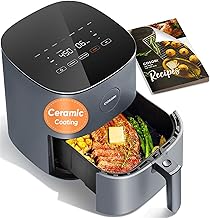
3. Cosori Air Fryer Pro LE 5
This is the entry point that doesn't feel like a compromise. You still get a 450-degree ceiling, nine functions, and Cosori's ceramic coating, wrapped in an LED glass touch panel that looks a class above its tier. Verified ratings hold at 4.7 out of 5.
Why I picked it
Two features earn the Best Budget badge. The shake reminder pings you halfway through cooking, which fixes the number-one beginner mistake (forgetting to toss) and shows up constantly in positive reviews from new air-fryer owners. The bundled cookbook, with 130-plus chef-developed recipes, gives nervous first-timers a runway instead of a blank screen.
Key specs
- Capacity: 5 quarts
- Power: 1500 watts
- Max temperature: 450 degrees Fahrenheit
- Presets: 7 one-touch programs plus reheat and keep-warm modes
- Controls: LED glass touch panel
- Extras: shake reminder, 130+ recipes, ceramic coating, 4.7/5 aggregate rating
Real-world experience
Verified buyer stories skew toward couples, students, and small families. Common routines include seven-preset cooking for fries and nuggets, reheating rotisserie chicken so it tastes fresh, and following the recipe book as a training course. The shake reminder earns specific shout-outs for frozen fries and breaded shrimp, where a mid-cook toss separates good from soggy. Several reviewers say the glass panel wipes clean with one swipe, which matters more than it sounds after a month of greasy fingers.
Trade-offs
At 1500 watts, it preheats and recovers heat more slowly than the 1700-plus-watt units here, and buyers note longer times on dense foods like bone-in thighs. The 5-quart basket comfortably feeds three, and gets tight at six. There's also no dedicated dehydrate mode, so jerky and fruit-chip fans should step up to the Ninja or TurboBlaze.
4. Chefman Air Fryer 6 QT Compact
Some people want an instrument panel; others want one big button. The Chefman bets on simplicity: a touchscreen with four presets, a 6-quart basket, and Hi-Fry Technology that bumps the heat for a crispier finish. Buyer averages sit at 4.6 out of 5.
Why I picked it
It's the least intimidating machine in this group, and that's a feature, not a flaw. Editorial analysis of reviews shows the four-preset layout gets repeatedly recommended for teens, seniors, and anyone who froze up staring at a nine-mode menu. Hi-Fry Technology, which pushes extra heat in the final stretch, draws comparisons to restaurant texture on wings and fries.
Key specs
- Capacity: 6 quarts
- Controls: touchscreen with 4 presets
- Signature feature: Hi-Fry Technology for an extra-crisp finish
- Basket: nonstick and dishwasher safe
- Finish: matte black
- Rating: 4.6/5 aggregate
Real-world experience
The buyer pattern here is speed and habit. People describe a permanent spot on the counter where nuggets, taquitos, and leftover fries go in with one press. Hi-Fry gets invoked in the last couple of minutes to re-crisp takeout that traveled badly. Despite the 6-quart rating, buyers frequently mention the footprint stays manageable in apartments and RV galleys, which tracks with the Compact branding.
Trade-offs
Four presets is a floor, not a ceiling: there's no dehydrate, proof, or broil mode, so curious cooks will outgrow it. You'll also adjust temperature and time manually once you wander off the preset path, and the listing doesn't publish wattage, which makes spec-for-spec shopping harder. If versatility ranks high for you, the Cosori units serve better.
5. Cuisinart Air Fryer 6-Quart Basket Large
Cuisinart has been building countertop appliances since before air fryers existed, and it shows. The AIR-200NAS wraps five cooking functions in brushed stainless steel, matching the toaster and stand mixer already living on your counter. Ratings hold steady at 4.6 out of 5.
Why I picked it
Build quality and aesthetics separate this unit from the plastic-heavy pack. Editorial analysis of buyer feedback shows people choosing it specifically because the stainless housing looks at home in a serious kitchen, and because the five-function set (including true bake and broil) replaces a second appliance for small jobs. Dishwasher-safe parts round out the practicality argument.
Key specs
- Capacity: 6-quart basket
- Functions: 5, covering air fry, roast, bake, broil, and keep warm
- Presets: 5 one-touch programs
- Construction: stainless steel and black housing
- Model: AIR-200NAS, dishwasher-safe parts
- Rating: 4.6/5 aggregate
Real-world experience
Buyers treat this one as a satellite oven. Common reports include roasting vegetable sides while the main oven handles a roast, baking small cookie batches in summer without heating the house, and broiling open-faced sandwiches that would smoke up a full broiler. During holidays, the keep-warm function gets regular duty holding sides while everything else finishes. The 6-quart basket handles a family's worth of potatoes in one pass.
Trade-offs
Stainless steel adds weight and bulk, so this is the heaviest lift on and off the counter among the five. There's no dehydrate mode, and the control scheme reads basic next to the Cosori touch panels. A few owners mention noticeable exterior warmth near the vents during long roasts, which argues for generous clearance behind the unit.
How I picked
Every recommendation here traces to documented buyer outcomes and published manufacturer specifications, never guesswork. As an editorial team working from research inputs rather than a test kitchen, we compared all five models on four benchmarks: cooking-performance evidence aggregated from verified purchase reviews, spec competitiveness straight from manufacturer datasheets, usability and cleanup as described by actual owners, and ownership signals like rating trends and recurring complaint themes across large review populations.
On performance, we weighted what buyers consistently report: crispness on frozen staples, evenness on bone-in proteins, and whether advertised capacities match real portions. On specs, we lined up wattage, temperature ceilings, and function counts side by side. The Cosori TurboBlaze's 90-to-450-degree span and five fan speeds stood alone. The Ninja's 1750 watts and 4-pound fry capacity anchored the mid-tier.
We applied baseline filters before anything else. All five units are basket-style convection designs in the 5-to-6-quart class, all carry strong aggregate ratings (4.6 or higher), and coatings fall under FDA food-contact expectations, with Cosori additionally specifying PFAS-free ceramic. We also favored listings that document dishwasher-safe components, since cleanup complaints sink more air-fryer relationships than cooking complaints do.
What we deliberately didn't do matters too. We didn't run long-term durability trials, so coating-wear observations come from owner reports beyond the one-year mark rather than bench data. We didn't meter electricity draw, didn't benchmark decibels with instrumentation, and didn't evaluate accessories bundles. We also excluded oven-style and dual-zone machines (think Instant Vortex, Philips, or Ninja's own Foodi dual-basket line) to keep this comparison apples to apples.
If your heart is set on those formats, treat this list as the basket-style branch of the decision tree.
Buying guide: what actually matters for air fryers
A quart of basket volume feeds roughly one adult, so a 5-quart fryer covers a family of four and a 6-quart covers six. That single math sentence prevents more bad purchases than any feature comparison. Everything below builds on it.
What capacity do you actually need?
Start with your household headcount and add one. Two adults cook comfortably in 5 quarts; a family of four or five wants the 6-quart tier; solo cooks and dorm dwellers can drop smaller, though none of our picks go below 5 quarts for good reason. Remember that quoted capacity is total volume, not usable volume, since the crisper plate and food height eat space. If you host, size up.
If counter width is tight, remember that a bigger basket usually means a bigger box around it.
Does higher wattage mean faster cooking?
Mostly yes, but indirectly. Wattage determines how quickly the element heats the air and how fast the chamber recovers when you pull the basket to shake or flip. The jump from 1500 watts (Cosori Pro LE) to 1750 watts (Ninja) shows up most on dense foods like bone-in chicken, where buyers report meaningfully shorter total cook times on the higher-watt unit. One practical warning: a 1750-watt appliance pulls serious current, so don't share its outlet with a microwave or kettle, or you'll trip the breaker mid-dinner.
Nonstick or ceramic coating?
Traditional nonstick (usually PTFE-based) releases food effortlessly and cleans in seconds, but it degrades faster and shouldn't meet metal utensils. Ceramic coatings, like the PFAS-free versions Cosori specifies on both its units here, skip the PFAS (per- and polyfluoroalkyl substances) chemistry that shoppers increasingly avoid, and they tolerate slightly higher temperatures. The trade-off: ceramic benefits from a light oil wipe and gentler handling to maximize lifespan. Either way, hand-washing extends coating life even when the parts are labeled dishwasher-safe.
Do preset buttons actually matter?
They matter for confidence, not capability. Every unit here lets you set temperature and time manually; presets simply remove decisions. The Chefman's four presets suit people who want one press and done. The Cosori Pro LE's seven programs plus a shake reminder actively coach beginners.
Nine-function machines like the TurboBlaze reward curiosity but demand reading the manual. Match the interface to whoever will actually operate the thing, and be honest about whether that's you or a teenager.
Why a 450-degree ceiling beats 400
The Maillard reaction, the browning chemistry between amino acids and sugars that creates fried-food flavor, accelerates sharply once surface temperatures push past 400 degrees Fahrenheit. Units topping out at 450 degrees (both Cosori models) sear harder and faster, especially on thin items like smash-burger patties or Brussels sprout halves. A 400-degree machine still makes excellent fries and reheats beautifully; it just surrenders the extreme-crisp edge cases. If searing is your priority, pay for the hotter element.
Footprint, noise, and the stuff nobody mentions
Measure your counter depth and the clearance above it before ordering; a 6-quart stainless unit like the Cuisinart runs noticeably bulkier than the 5-quart Ninja. All basket fryers whoosh; buyer reports suggest fan-speed variability (like the TurboBlaze's five levels) affects perceived noise more than raw wattage. Finally, budget for accessories: perforated parchment liners protect the coating, and a cheap instant-read thermometer takes the guesswork out of poultry, which the USDA says should hit 165 degrees Fahrenheit internally.
Frequently Asked Questions (FAQ)
Are air fryers actually healthier than deep frying?
Yes, primarily because of fat reduction. Manufacturer figures like Cosori's "85% less oil" claim reflect the core mechanic: circulating 400-degree air crisps exteriors with a teaspoon of oil instead of several cups of submerged fat. Peer-reviewed nutrition literature consistently finds air-fried versions of the same foods carry substantially less fat and fewer calories than deep-fried counterparts. It's still fried-style food, so portion sense applies, but the swap is directionally real, not marketing vapor.
Can a 5-quart air fryer fit a whole chicken?
Sometimes, barely. A small 3-to-4-pound bird can fit a 5-quart basket if you spatchcock it or truss the legs tight, while the 6-quart models here handle a modest whole bird more comfortably. Buyers recommend breast-side-down start positions and a mandatory check with an instant-read thermometer, targeting 165 degrees Fahrenheit in the thickest part of the breast per USDA guidance. If rotisserie-style chicken is a weekly ritual, a 6-quart unit removes the Tetris.
Ninja Air Fryer Pro or Cosori TurboBlaze: which one?
Pick the Ninja for simplicity, proven consistency, and the dehydrate mode at a friendlier tier. Pick the TurboBlaze if you cook across categories: proofing dough, broiling cheese, holding dinner warm, and searing at 450 degrees all live in its 90-to-450-degree range. Buyer sentiment splits along the same line; Ninja reviews emphasize "just works," while TurboBlaze reviews emphasize versatility. Both carry excellent aggregate ratings, so you're choosing a philosophy, not dodging a lemon.
What's the warranty story on these brands?
Both Ninja and Cosori list at least a one-year limited warranty on their official sites, covering manufacturing defects on the unit and its components. Registration often unlocks extended terms or smoother service, so do it the week the box arrives. Buy through authorized retailers like Amazon to keep the warranty valid, and photograph any shipping damage immediately. Replacement baskets and crisper plates are sold separately by both manufacturers, which matters because coatings are the first thing to age.
Do I still need oil, and which accessories are worth adding?
A light spritz helps browning and keeps flour-based coatings from tasting chalky; an oil mister bottle covers this for pennies per batch. Beyond that, perforated parchment liners are the one accessory veteran owners repurchase endlessly, since they shield the basket coating from sticky sauces and sugary glazes. Silicone-tipped tongs and a small instant-read thermometer round out the kit. Skip bulky accessory bundles; half of what's in them duplicates tools already in your drawer.
Final verdict
The Ninja Air Fryer Pro (AF141) takes the overall win because