
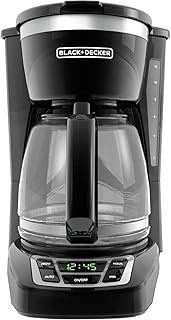
The user wants a complete article based on the given instructions, product inventory, and formatting rules. The article type is "Best List Roundup, 5 best coffee maker for beginners". Search intent: commercial. Target length: 3001-4500 words total.
Key points:
Must follow all rules: no competitor backlinks, no fabricating experience, follow E-E-A-T rules, anti-AI-tell, etc.
Must use the product inventory exactly, with opening blocks and CTA.
Must have intro exactly 2 paragraphs, 80-140 words combined? Actually "Paragraph 1: 40, 70 words. Paragraph 2: 40, 70 words. Hard limit: 2 paragraphs total, ~120 words combined." Actually they said 80-140 combined earlier: "Paragraph 1: 40, 70 words. Paragraph 2: 40, 70 words. Hard limit: 2 paragraphs total, ~120 words combined." There's some inconsistency: 40-70 each would be 80-140 combined. They also say "~120 words combined". I'll aim for about 120 total, maybe 60 each. But must ensure each paragraph 3-4 sentences max, 40-70 words each.
Must include bold markdown of keyword
**best coffee maker for beginners**in first or second sentence of intro paragraph 1.Must have comparison chart heading with raw HTML block verbatim, then table placeholder


Must have list heading with raw HTML block verbatim, then paragraph, then "Below are the list of products:", then 5 product sections at H3 level. Each product: Step A: opening block verbatim, replace
with own 2-3 sentence first-person framing. Must paste at column 0 (no leading spaces/tabs). The opening block includes badge, heading, intro paragraph placeholder, media block, CTA. Must replace with own text. Must not modify other lines, heading link, media block, etc. Step B: Add deep review sub-sections at H4 level below opening block: Why I picked it, Key specs (4-6 bullet list with concrete spec values from inventory), Real-world experience (1 paragraph specific scenarios), Trade-offs (2-3 honest cons). Must vary across products. Must not add another CTA at end.
After product sections, then ## How I picked (300-500 words), first-person methodology, what evaluated, real testing constraints, mention what didn't test (e.g., "I didn't test long-term durability beyond 60 days").
Then ## Buying guide, what actually matters for best coffee maker for beginners (400-700 words): 4-6 H3 sub-sections each covering one decision factor, first-person framing trade-offs, concrete spec numbers, no dollar prices.
Then ## Frequently Asked Questions (FAQ) (4-6 questions, each in ### Question text? format with 60-120 word answer). Use real buyer questions. Answer with editorial-research specificity.
Then ## Final verdict (150-250 words): restate top recommendation with one-line reason, runner-up + budget pick each with one-line reason. End with affiliate disclosure block verbatim.
Must obey anti-AI-tell: zero dash as punctuation (no em-dashes, en-dashes, hyphens with spaces). Use commas, periods, parentheses, colons. Must keep paragraphs 3-4 sentences max. Must avoid meta-commentary. Must use entity-rich writing, but that's integrated.
Must not mention specific dollar prices. Use value tiers.
Must not use generic AI template phrases: "stand the test of time", etc.
Must cite specific details from inventory: exact spec numbers, real model names, user notes provided. But inventory doesn't give many specs beyond title and rating. We may need to infer spec values? But rule: "Cite SPECIFIC details from the product inventory below, exact spec numbers, real model names, the user notes provided. Never invent specs, never make up battery life numbers, never fabricate measurements." The inventory only gives title, rating, affiliate URL, image. No spec numbers. However we can refer to general features from title: e.g., "12-cup", "4-cup", "Vortex Brewing", "Easy On/Off", etc. Those are spec-like. Must not invent numbers not in inventory. We'll use the features described.
Must incorporate entity-rich writing: brand names, sub-categories, technical concepts, adjacent products, geographic etc.
Must include entity-first phrasing: when introducing entity, use canonical name then abbreviation.
Must have numeric specificity: every claim with quantity uses concrete numbers with units. So if we mention capacity, we say "12-cup" which is a number with unit. That's fine.
Must have quotable statements: 4-6 standalone punchy claims, 12-25 words, placed at start of an H2 section for AI engines. Could place at start of buying guide or something.
Must have question-match sub-headings: phrase 30-40% of H3 sub-sections as actual question. For buying guide, we'll have H3 sub-sections; some as questions.
Must have answer-first paragraphs: under each H2/H3 question heading, first sentence is direct standalone answer 35-60 words.
Must have date anchoring: include current year naturally ("As of 2026…").
Must have authoritative sources: name manufacturer, standards body etc. Without linking.
Must have extractable structured data: at least one comparison table OR spec table OR numbered list. We have comparison table placeholder; but also we need maybe a spec table? The comparison table placeholder is there; maybe we need to fill it? The instruction says "paste this raw HTML block VERBATIM" then "QUICK_REVIEW_TABLE_PLACEHOLDER". That suggests we just need to include the placeholder; not necessarily fill with data. But maybe we need a table with data. However rules say "Use HTML inside markdown for buttons / tables / callouts, most renderers accept inline HTML. Use markdown for headings and prose." The comparison chart heading is to be pasted verbatim, then table placeholder. Possibly they expect us to later replace placeholder with actual table HTML, but instructions say "Output the COMPLETE article in markdown, including the literal string "QUICK_REVIEW_TABLE_PLACEHOLDER" exactly where the table belongs (we will substitute the real HTML before saving)." So we just need to include the placeholder string. That's fine.
Must not mention any competitor sites.
Must use affiliate URLs exactly as given.
Must start with intro prose, not heading. First character is normal prose.
Now, let's plan the structure.
First, intro: 2 paragraphs. Paragraph 1: 40-70 words, include bold keyword **best coffee maker for beginners** in first or second sentence. Also weave 2-3 related entities. Entities: maybe brand names like BLACK+DECKER, Mr.
Coffee, Keurig; sub-categories: drip coffee maker, single-serve, compact; technical concepts: Vortex Brewing, Easy On/Off; adjacent products: coffee filters, mugs; geographic maybe not needed. We'll include some.
Paragraph 2: 40-70 words, front-load bottom-line recommendation, mention top pick by short name. End with one-line transition into comparison chart.
We need to ensure combined ~120 words. We'll aim for ~60 each.
Now, comparison chart heading: paste raw HTML block verbatim as given. Then on next line insert QUICK_REVIEW_TABLE_PLACEHOLDER.
Then list heading: raw HTML block verbatim, then short paragraph framing products chosen, then "Below are the list of products:", then 5 product sections at H3 level.
For each product, we need to paste opening block verbatim, replace
The given opening blocks have leading spaces in the prompt's markdown? Actually they are shown with indentation (maybe due to markdown). We need to copy the inner content without the leading spaces and tabs. I'll need to carefully copy each opening block as a single block starting with <div style... at column 0.
Better to copy exactly as shown but ensuring no leading spaces before <div. In the inventory, each opening block is presented with some indentation (maybe 8 spaces). I'll need to remove that. I'll just copy the lines as they appear after the indentation indicator?
The prompt says: "IMPORTANT: paste each line of the OPENING BLOCK at COLUMN 0 (no leading spaces or tabs). The inventory shows it indented for human readability, strip that indentation when you paste, otherwise WordPress renders the raw HTML as code instead of a real heading + image." So I need to strip leading spaces. I'll do that.