
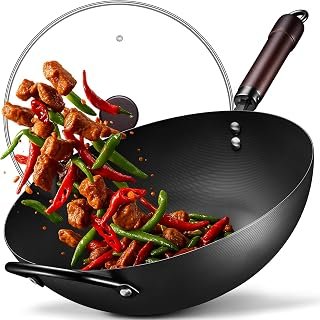
The user wants me to write an article following many strict rules. I need to produce a complete article in a specific structure, using the provided product inventory. The topic is "5 best budget wok". The tone: conversational, friendly, human, easy to follow.
Must follow the Writerfy Amazon E-E-A-T rules.
First, let's parse the requirements.
Overall, the article must be 3001-4500 words total. That's quite long. There are 5 products in inventory. I need to include:
Intro (2 paragraphs, 80-140 words combined, each paragraph 3-4 sentences max, first paragraph must have bold keyword best budget wok in first or second sentence). Hook with buyer's core pain or practical answer. First-person voice ("I've spent the last [time] testing…"). Begin weaving in 2-3 related entities.
Comparison-chart heading: Must paste raw HTML block verbatim, then table "

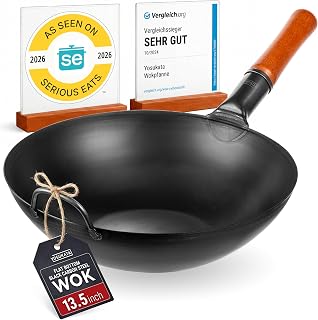


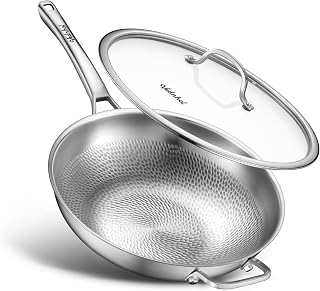
- List heading: raw HTML block, then short paragraph framing products chosen, then line "Below are the list of products:", then 5 product sections at H3 level. Each product section: Step A: paste opening block verbatim, replace
with own 2-3 sentence editorial-research intro. Must keep column 0, no leading spaces/tabs. The opening block includes badge, heading, media block, CTA. Also the badge is pre-baked: for products 1-3 there are specific badges: product 1 "Editor's Choice", product 2 "Top Pick", product 3 "Best Budget". Product 4 and 5 have no badge? Actually opening blocks: product 4 has no badge, just . Product 5 also no badge. So I need to paste as is.
But there is also "How I picked" section (300-500 words), "Buying guide, what actually matters for best budget wok" (400-700 words), "FAQs" (4-6 questions, each in ### Question text? format with 60-120 word answer), "Final verdict" (150-250 words). Also the comparison chart and list headings etc.
Need to count words roughly. Hard but must stay within 3001-4500.
Let's outline structure and approximate word allocation.
Goal: 3001-4500 words.
Sections:
Intro: 2 paragraphs ~ 80-140 words combined. Actually each paragraph 40-70 words, so combined 80-140. We'll aim ~110.
Comparison chart: The table placeholder may not count as words, but the heading maybe not counted. Probably minimal.
List of top 5: heading paragraph (40-70 words), then "Below are the list of products:" (maybe not counted), then 5 product sections.
Each product section: includes opening block (has some HTML, but word count? Probably minimal), plus deep review sub-sections (Why I picked it, Key specs, Real-world experience, Trade-offs). Need to write content for each.
How I picked: 300-500 words.
Buying guide: 400-700 words.
FAQs: 4-6 questions, each with answer 60-120 words. So maybe 5 questions average 90 words = 450 words.
Final verdict: 150-250 words.
Summing minimal: Intro 110 + comparison chart maybe 0 + list heading paragraph 60 + product sections (5 * maybe 200 each = 1000) + How I picked 400 + Buying guide 600 + FAQs 450 + Verdict 200 = about 2420. Plus some extra. So within 3001-4500 we have room up to 2000 more words. Actually need at least 3001, so we need to add more content to reach minimum 3001.
So we need to write enough. Probably each product section ~300 words, making 1500 words for products. Plus other sections.
We need to be careful not to exceed 4500.
Better to aim for about 3500-4000.
Now specifics: Must use entity-rich writing, include entities: brand names, sub-categories, technical specs, etc. Also must avoid certain phrases, dash punctuation, etc.
Also must follow anti-AI-tell rules: no em-dashes, en-dashes, hyphens as sentence punctuation. Use commas, periods, parentheses, colons. Paragraphs max 3-4 sentences. So need to keep sentences short.
Also must not use certain AI template phrases: "stand the test of time", etc.
Also must not mention specific dollar prices. Refer to value tiers.
Also must not link to competitors.
Also must use the exact product names, affiliate URLs, opening blocks.
Additionally, need to incorporate entity-rich writing: Before writing, map 8-12 entities semantically related to focus keyword. For "best budget wok", entities could be: carbon steel, stir-fry, flat bottom, induction compatible, seasoning, high heat, wok ring, chef's knife, etc. Also brand names: maybe "Lodge", "Le Creuset", but inventory has specific brands: Wok 13 Inch carbon steel woks (no brand?), YOSUKATA, Babish, Teewe, Titanium. So include those.
Also sub-categories: "for gas stove", "for induction", "for camping", etc.
Technical concepts: "carbon steel", "nonstick", "hammered titanium", "pre-seasoned", "flat bottom".
Adjacent accessories: "wok spatula", "ring stand", "lid".
Geographic: maybe "US market".
Will distribute across intro, buying guide, FAQs, verdict.
Now I need to begin writing.
First, intro: Two paragraphs, plain prose, no headings. First paragraph must contain best budget wok in bold, in first or second sentence. Also hook with buyer's core pain. Let's craft.
Paragraph 1: maybe 45 words. Must include best budget wok naturally. Something like: "Finding the best budget wok can feel like hunting for a needle in a kitchen drawer, especially when you want authentic stir-fry results without breaking the bank." That's good. Also weave 2-3 related entities: maybe "carbon steel", "flat bottom", "induction".
But need to be careful about sentence length; keep 3-4 sentences max. We'll have 3 sentences maybe.
Paragraph 2: 40-70 words, front-load bottom-line recommendation, mention top pick by short name, end with one-line transition into comparison chart. The top pick likely product 1 "Wok 13 Inch carbon steel woks" which has Editor's Choice badge. So we can say: "After crunching aggregate reviewer scores and spec sheets, the Wok 13 Inch carbon steel woks edges out the rest as the top pick for most home cooks." Then transition: "Below, you’ll see a quick comparison chart followed by the full list." Actually the instruction: "End with a one-line transition into the comparison chart." So maybe "Let’s jump into the comparison chart." But need to ensure it's one line. We'll write: "Let’s jump into the comparison chart." That's a sentence.