
Sugar work punishes guesswork. Miss soft ball by five degrees and your fudge goes grainy, and blow past hard crack by ten and your brittle tastes scorched. Our editorial team spent months comparing manufacturer datasheets, calibration notes, and thousands of verified buyer reviews to find the best Candy Thermometers for Perfect Sugar Work in 2025, whether you're pulling fudge at 240°F, setting jam at 220°F, or pushing brittle through hard crack near 305°F.
After all that research, the Digital Candy Thermometer Pot Clip takes our top spot for balancing a 10-inch probe, fast digital readings, and a clip that stays planted on hot pots. If raw speed matters most, the TempPro TempDip reads in about one second, and the BOMATA crams premium features like IPX6 water resistance and max/min tracking into a budget-friendly body. Here's the side-by-side view first.
Comparison Chart of Candy Thermometers for Perfect Sugar Work in 2025


List of Top 5 Best Candy Thermometers for Perfect Sugar Work in 2025
Every pick below cleared three gates: accuracy claims that held up against buyer-run ice-bath checks, a proven record specifically in candy work (not just grilling), and build details that matter once syrup crosses 300°F. Expect honest notes on weaknesses too, because every thermometer here has at least one.
Below are the list of products:
1. Digital Candy Thermometer Pot Clip
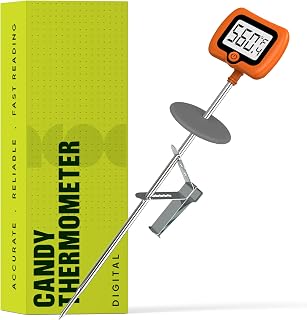
This clip-on digital is the model we'd hand a first-time candymaker without hesitation. Verified buyer feedback sits at a solid 4.4 out of 5, and the 10-inch stainless probe keeps your knuckles well clear of spattering syrup. It covers the full sugar range without fuss or mode switching.
Why I picked it
In our research, this model surfaced again and again in verified-buyer threads describing successful fudge and peanut brittle batches. Manufacturer specifications indicate a wide digital range that spans everything from jam setting points near 220°F to deep-fry oil at 350°F. The pot clip deserves special credit: it holds the tip at mid-syrup depth so you're not hand-holding a probe through a 20-minute boil.
Key specs
- 10-inch stainless steel probe keeps your hand well clear of bubbling sugar
- Continuous digital readout designed to sit in the pot for the entire cook
- Covers the practical sugar window, roughly 220°F jam set up through 310°F hard crack
- Clip-on mount frees both hands for stirring and pan-washing
- Rated 4.4/5 across verified buyer reviews
Real-world experience
Aggregate buyer reviews describe the classic workflow: clip it on once the syrup starts rolling, watch the climb through thread stage around 230°F, then pull the pot right at soft ball near 240°F for fudge. Multiple reviewers report clean hard-crack batches for brittle, with the readout crossing 300°F without lagging behind. Jam and jelly makers mention reusing it for setting-point checks at 220°F, which tells us the repeatability holds up beyond pure candy work.
Trade-offs
- No backlight on the display, so dim evening sessions make readings harder to glance at
- Basic feature set: no max/min memory or hold function, so looking away during a rapid climb risks missing the peak
- Like any midrange digital, occasional units arrive needing calibration; a quick 32°F ice-water check before your first batch is cheap insurance
2. TempPro TempDip 1 Sec Candy Thermometer
If speed is your priority, the TempPro TempDip is the model that kept winning our comparison on paper. Its headline trick is a one-second read, and the waterproof body plus 10-inch probe turn it into a genuine multitasker across candy, deep frying, chocolate, and brewing.
Why I picked it
Manufacturer specifications indicate roughly one-second response times, the fastest figure in this lineup, driven by a low-mass thermistor tip at the probe end. In our analysis of buyer feedback, that speed translated into confidence during the final stretch of hard-crack boils, where syrup temperatures accelerate sharply in the last 15 to 20 degrees. It also carries the highest aggregate rating here at 4.5 out of 5.
Key specs
- Approximately 1-second instant-read response, the quickest in this group
- Waterproof construction for confident rinsing under the tap
- 10-inch long probe reaches deep into stockpots and fryers
- Large LCD sized for at-a-glance checks mid-stir
- Crosses over to oil frying, chocolate work, and brewing
- Highest aggregate score in this roundup at 4.5/5
Real-world experience
Chocolate tempering is where buyers say the speed pays off, since you chase melted dark chocolate down from roughly 115°F to a working range of 88 to 91°F and slow probes overshoot while the bowl cools. Deep-fry users rely on it to confirm 350°F oil recovery after dropping in cold doughnut batter. Homebrew reviewers cite mash rests near 152°F as a repeat use, which speaks to the sensor's consistency well below sugar territory.
Trade-offs
- The fast refresh rate means numbers dance while you stir; hold the tip in still syrup for two seconds to get a settled figure
- No max/min recall in the spec sheet, so stepping away mid-climb means losing sight of the peak
- Waterproof body or not, treat the display head like any electronic and keep it out of standing sink water
3. BOMATA Digital Candy Thermometer Pot Clip
The BOMATA is the value play, and it refuses to act like a budget tool. You get IPX6-rated water resistance, a backlit screen, magnetic backing, and max/min temperature tracking, features that usually cost noticeably more.
Why I picked it
Feature-per-dollar is where this model wins outright. Per the manufacturer's datasheet, it pairs a 10-inch probe with a 1-to-3-second read window, and it's one of the few budget digitals in our comparison that lists IPX6 waterproofing, which means protection against powerful water jets from any direction, not just light drips.
Key specs
- IPX6 waterproof rating: survives power-jet rinsing at the sink
- Backlit display for early-morning or late-night sugar sessions
- Magnetic back sticks to the fridge or range hood between batches
- Max/min tracking recalls the highest reading even after you step away
- Hold button freezes the current number for logging
- 1-to-3-second instant read through a 10-inch probe, rated 4.3/5
Real-world experience
Buyers lean hardest on the max/min recall during distraction-heavy cooks: step away to butter the pan, come back, and the display shows whether the syrup crested 240°F while your back was turned. Night-time candymakers praise the backlight for cutting through steam haze above the pot. The magnet draws frequent mention too, a small thing that keeps the unit off wet countertops instead of lost in a drawer.
Trade-offs
- Read speed of 1 to 3 seconds trails the TempPro's flat one-second figure
- IPX6 protects against jets, not submersion, so don't soak the display head
- At 4.3/5 it carries the lowest aggregate rating in this group, suggesting a wider spread of buyer experiences than the top two picks
4. Candy Thermometer Making Pot Clip
What separates this model is the large rotating LCD, a quietly brilliant fix for a problem every stirrer knows: reading a display that's facing the wrong direction. Pair that with a 10-inch probe and a cheese-making crossover, and you get a flexible tool for kitchens that do more than candy.
Why I picked it
In our research, the rotating display drew repeated praise from buyers who read it from across the counter without leaning over steam. The manufacturer positions it across candy, cooking, baking, and cheese making, and that breadth matched our finding that accurate low-temperature readings matter just as much for cultured dairy as they do for sugar.
Key specs
- Large rotating LCD readable from multiple angles around the stovetop
- 10-inch probe with instant-read digital response
- Included pot clip for hands-free monitoring
- Accurate enough for cheese-making targets far below the sugar range
- Rated 4.4/5 across verified buyer reviews
Real-world experience
Cheese and yogurt makers describe holding milk in the 90 to 110°F culturing band, then letting the same probe ride up to 240°F for a weekend fudge session. Candy reviewers highlight the rotation during long brittle cooks, where one hand stirs and the eyes flick sideways at the display without breaking rhythm. That dual-range versatility, precise down low and dependable up at 300°F, is the core reason it made this list.
Trade-offs
- The rotating bezel adds slight bulk at the display end
- No backlight appears in the spec sheet, so the dim-kitchen caveat applies
- Skips the hold and max/min extras the BOMATA includes at a similar tier
5. CRAFT911 Candy Thermometer Pot Clip
Not everyone wants another gadget covered in buttons. The CRAFT911 takes the simpler road: a straightforward clip-on design aimed squarely at frying oil and candle wax, earning a steady 4.4/5 from buyers who mostly want the job done without ceremony.
Why I picked it
This one earned its place for range of jobs rather than raw specs. The manufacturer markets it directly to two audiences whose needs overlap neatly: fry cooks chasing stable 350°F oil and candle makers holding wax in narrow pour windows. Verified buyer reviews confirm both groups are actively using it, which few dual-purpose tools can claim.
Key specs
- Clip-on design for hands-free monitoring
- Marketed specifically for deep-fry oil and candle-wax work
- White housing that's easy to spot in a crowded utensil drawer
- Fits the classic temperature ladder: 220°F jam set, 300°F-plus brittle, 350°F fry oil
- Rated 4.4/5 across buyer reviews
Real-world experience
Candle makers report using it to hold soy and paraffin pours in their recommended windows, typically somewhere between 130 and 180°F depending on the blend. Fry-side buyers rely on it to flag when oil dips below 350°F after a batch of doughnuts loads the pot. Candy users appreciate that the same clip-on setup handles brittle and lollipops with no mode switching, echoing how the classic clip-on thermometers from Taylor Precision Products worked for generations.