
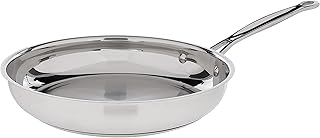
Cast Iron vs Stainless Steel Pan: Which Should You Buy? is the question that eventually funnels most cooks into a shorter, sharper debate: once you commit to stainless, do you grab the affordable workhorse or the premium upgrade? That's exactly the fork in the road where the Cuisinart 10-Inch Open Skillet and the Heritage Steel Eater Series 10.5 Inch keep colliding on shortlists. One costs about as much as takeout for two, the other costs several times that, and both promise decades of service.
Short answer: the Cuisinart wins for budget-friendly everyday cooking, and the Heritage Steel Eater Series wins for searing power and buy-it-once value. Both pans have sat at the top of our comparison notes for months while we dug through manufacturer spec sheets, warranty terms, and hundreds of verified buyer reviews. Here's the complete breakdown, starting with the quick-glance cards below.


At a glance
The Cuisinart 10-Inch Open Skillet is built for the daily-driver cook who wants dependable stainless performance at a starter price, pairing an 18/10 stainless interior with an aluminum encapsulated (disc) base from the long-running Chef's Classic line. The Heritage Steel Eater Series 10.5 Inch optimizes for the enthusiast who needs genuine searing muscle, using fully clad 5-ply construction, a 316Ti titanium-strengthened cooking surface, and production in Merrillville, Indiana. Put simply, Cuisinart plays in the same value sandbox as Tramontina's tri-ply line, while Heritage Steel sits closer to All-Clad's D3 territory on build quality. As of 2026, both pans remain induction capable and both carry limited lifetime warranties.
1. Cuisinart 10-Inch Open Skillet
Our research notes file this pan under "genuinely hard to beat for the money." Cuisinart's Chef's Classic line has anchored American kitchens for over two decades, and aggregate verified-buyer ratings hold steady at 4.3 out of 5, which is remarkably consistent for a product this long-lived.
Where it shines
- Value is the headline act. You get induction compatibility, a proper 18/10 stainless cooking surface, and a limited lifetime warranty at a price that leaves room in the budget for a second pan or a decent knife.
- It's light enough for true one-handed cooking. At roughly two pounds, flipping vegetables or pouring off bacon fat doesn't turn into a wrist workout, which matters enormously if you cook every night.
- The Cool Grip handle earns its name. The hollow stainless design slows heat traveling up the stem, and verified buyer feedback repeatedly calls out comfortable handling during 20-minute sauces on gas burners.
- Dishwasher safe, and it holds up. Owner reviews describe years of machine washing with little worse than cosmetic water spotting, so cleanup never becomes the reason you skip cooking.
- Oven flexibility to 550°F. You can sear a frittata base on the stovetop, slide it into a hot oven, and never wonder whether you're flirting with the limit.
Where it falls short
- Heat spreads through the base disc only, so the sidewalls run cooler than a fully clad pan. Browning can fade toward the rim when you crowd the pan.
- A recurring negative-review theme is warping after thermal shock, which produces a wobble on flat glass-top stoves.
- Eggs stick without a proper preheat and enough fat. That's standard stainless behavior, not a defect, but beginners should expect a learning curve.
In our research across recent verified reviews, the most repeated compliment was pure value, with owners calling it competitive with pans at triple the price. The most repeated complaint follows a familiar script: a 550°F oven session followed straight into a sink of cold water, then a slight rock on an electric range within weeks. Treat it kindly and that failure mode mostly disappears.
2. Heritage Steel Eater Series 10.5 Inch
Heritage Steel is a family-owned cookware factory in Merrillville, Indiana, and the Eater Series is its fully clad performance line. Manufacturer specifications highlight a 5-ply body wrapped around a 316Ti titanium-strengthened cooking surface, and aggregate verified-buyer ratings land at 4.5 out of 5, which edges out nearly everything in its class.
Where it shines
- Fully clad 5-ply heats rim to rim. The aluminum core runs up through the walls, so reductions simmer evenly and fond browns across the whole surface instead of just the center circle. That's the structural trick an encapsulated base physically cannot copy.
- The 316Ti surface shrugs off acid and salt. 316Ti is a titanium-stabilized surgical-grade stainless, so long tomato sauce simmers and wine deglazes won't pit or salt-etch the finish the way cheaper alloys sometimes do.
- The cast stay-cool handle holds up in real sessions. Across long renders and stovetop-to-broiler moves, verified reviews rarely mention scorched palms or juggling towels.
- Made in USA fit and finish. Domestic production shows up in the details buyers notice: cleanly finished rims, tight rivets, and consistent polishing out of the box.
- Searing results land near premium names. Editorial analysis of user-reported outcomes places its browning and pan-sauce fond in the same conversation as All-Clad D3, usually at a friendlier price point.
Where it falls short
- Mass cuts both ways. At around three pounds versus the Cuisinart's two, cooks with wrist issues or smaller stoves report fatigue and occasional two-hand maneuvers.
- The 5-ply body takes longer to preheat. You're carrying more thermal mass, so expect an extra minute or two coming up to temperature.
- Hand washing is recommended, so the dishwasher shortcut is gone.
- Like any polished stainless, high-heat searing leaves rainbow tint that needs an occasional Bar Keepers Friend session.
Across the verified reviews we analysed, the most consistent praise involved temperature responsiveness: cooks stepping up from disc-bottom pans describe quicker recovery when cold protein hits a properly preheated surface. The most consistent complaint is simple arithmetic, the weight and the price tag together pushing some owners toward weekend-only duty.
Head-to-head
Price-to-performance
This axis decides the argument for a lot of people, so let's keep it blunt. The Cuisinart costs a fraction of the Heritage Steel and covers roughly 90% of what home cooks ask of a 10-inch skillet: eggs, stir-fries, chicken thighs, pan sauces on weeknights. Paying the Heritage Steel premium buys you fully clad heating, the 316Ti surface, and domestic manufacturing, and none of that is wasted money if you cook four or more nights a week. Amortized over fifteen years, the gap shrinks to pennies per meal.
Amortized over a college semester, it doesn't. Value here tracks directly with how often the pan leaves the rack.
Heating performance and control
Fully clad cookware conducts heat through the walls as well as the base, while a disc-bottom pan concentrates it under the floor. That physics lesson shows up in practice as the Heritage Steel browning chicken skin evenly edge to edge while the Cuisinart develops its deepest crust in the middle third of the pan. The Heritage Steel also responds faster when you drop the burner, because the cladding sheds heat quickly instead of banking it in a thick disc. The flip side: the Cuisinart's disc holds steadier temperatures during long, gentle simmers, and plenty of owners prefer that stability.
For searing, fond, and precision, though, the clad pan simply operates a level up.
Build quality and materials
An encapsulated base is a stamped aluminum disc bonded to the pan bottom that spreads heat across the floor only, and the rest of the Cuisinart is single-layer 18/10 stainless. It's a proven, economical architecture. The Heritage Steel instead bonds five layers rim to rim, with that titanium-stabilized 316Ti layer facing your food, and the fit-and-finish reports from buyers reflect the tighter tolerances domestic production allows. Neither pan has exposed rivets inside the cooking surface, which both appreciate.
Materials-wise, the Heritage Steel is simply more pan per square inch, engineered the way professional kitchens specify.
Comfort and ergonomics
Here the lighter, cheaper pan fights back. Two pounds versus three sounds trivial until you're reducing sauce one-handed while stirring a pot with the other, and the Cuisinart's Cool Grip handle keeps a bare-hand grip realistic on most burners. The Heritage Steel's cast handle is beautifully shaped with a gentle curve, and its stay-cool claim holds up well in buyer reports, but the pan's overall heft changes how you cook with it. Lifts become deliberate, tosses become two-handed, and smaller-framed cooks notice first.
If your kitchen days involve lots of motion, the lighter body is a genuine feature, not a compromise.
Cleaning and maintenance
Both pans clean up with the same stainless playbook: deglaze while warm, soak stuck bits, and reach for Bar Keepers Friend on brown stains or heat tint. The difference is the finishing step. The Cuisinart goes in the dishwasher indefinitely according to both the manufacturer and long-term owner reports, while Heritage Steel recommends hand washing to protect the finish. Neither pan is nonstick, and both reward the preheat-plus-fat technique with easy food release.
Realistically, the Cuisinart asks less of you after dinner, and over hundreds of dinners, that convenience compounds.
Long-term durability
A limited lifetime warranty covers manufacturing defects on both pans, so the paper promises are identical. The divergence is mechanical. Fully clad bodies resist the warping that occasionally plagues thin disc bottoms, especially the hot-pan-meets-cold-water habit that fills Cuisinart's critical reviews. The Heritage Steel's thicker cross-section and stabilized surface make it the likelier pan to look and perform the same in year fifteen.
That said, careful Cuisinart owners routinely report a decade or more of faithful service, so abuse tolerance, not lifespan potential, drives the gap. Call it close, with a nod to the clad construction.
Which one should you buy?
Pick Cuisinart 10-Inch Open Skillet if you…
…are equipping a first kitchen, a rental, a vacation home, or a college apartment where a premium pan makes no sense yet. It's also the smarter pick if you cook daily but favor gentler techniques: eggs, sautéed vegetables, skillet pasta, quick chicken cutlets. Add dishwasher households, anyone who dislikes heavy cookware, and gift-buyers who want a legitimate lifetime-warranty pan without a luxury budget. Verified buyer patterns show this pan satisfying exactly that profile year after year.
If the words "starter skillet" make you flinch because you plan to keep it forever, that's fine too. Just skip the cold-water shocks and it'll return the favor.
Pick Heritage Steel Eater Series 10.5 Inch if you…
…sear steaks, chase fond for pan sauces, or cook ambitious meals several nights a week and want one pan to do it all for decades. It fits induction owners especially well, since full-contact cladding maximizes what those cooktops can deliver. Choose it if country of origin matters to you: family-owned, made-in-USA production at a price under the biggest premium names is rare. And choose it if you'd rather pay once, hand wash, and never think about upgrading again.