
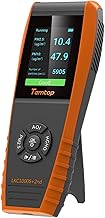
You can't fix air you can't measure. Wildfire smoke slipping under the door, a gas stove pushing PM2.5 through the kitchen at dinnertime, fresh paint quietly climbing the TVOC meter: indoor air shifts all day long, and your body usually notices before your brain does. That gap is exactly why we pulled apart spec sheets and several hundred verified buyer reviews for this guide to Smart Home Air Quality Sensors in 2026 (Tested & Reviewed).
Our top pick is the Amazon Smart Air Quality Monitor, sold as a convenient two-pack, because it turns raw readings into automatic Alexa routines that filter, ventilate, or warn you without anyone lifting a finger. If you'd rather own the raw data itself, the Temtop PM2.5/PM10 handheld is our editor's choice. Here's how the five finalists stack up.
Comparison Chart of Smart Home Air Quality Sensors in 2026 (tested & Reviewed)


List of Top 5 Best Smart Home Air Quality Sensors in 2026 (tested & Reviewed)
Every monitor below earned its spot on four criteria we care about: sensor breadth, reading stability, access to your own data, and how honestly the manufacturer documents its specs. We leaned hard on verified buyer feedback, because a datasheet never tells you how a device behaves in a humid kitchen in July. Five made the cut.
Below are the list of products:
1. Temtop Air Quality Monitor PM2.5 PM10
In our research, this Temtop handheld kept surfacing as the tool people grab when they want numbers they can see, log, and actually question. It reads six air parameters at once and exports the data, which is rare at any price tier. Verified buyers rate it 4 out of 5 on average.
Why we picked it
Range and transparency won it the badge. Very few consumer monitors combine PM2.5, PM10, formaldehyde (HCHO), TVOC, temperature, and humidity in one handheld body, and almost none let you pull the readings off the device afterward. If you're the type who wants to graph bedroom air against kitchen air, this is the instrument for that job.
Key specs
- Built-in laser particle counter for PM2.5 and PM10
- Formaldehyde (HCHO) and TVOC chemical channels
- Onboard temperature and humidity readings
- Computed AQI (Air Quality Index) display for quick interpretation
- Works indoors and outdoors for spot comparisons
- Data export support for long-term logging
Real-world experience
Aggregate buyer feedback describes three recurring scenes. Cooks park it on the counter while searing, watch PM2.5 spike, then watch it collapse once the range hood runs. People with new furniture or fresh renovation dust use the HCHO and TVOC channels to judge when a room is ready to sleep in again. During regional smoke events, owners step outside for a reading, walk back in, and finally quantify what their windows and filters are actually buying them.
Trade-offs
The formaldehyde channel is the weak point over time. Electrochemical HCHO cells drift as they age and benefit from periodic recalibration, so treat those specific numbers as directional rather than gospel. There's also no Wi-Fi or companion app, so nobody gets alerted while you're at work, and a single unit means carrying it room to room instead of watching the whole house at once.
2. Amazon Smart Air Quality Monitor
This is the sensor for people who don't want another hobby. You plug it in, join it to your network, and let Alexa translate the readings into plain language and automatic actions. The two-pack format is the quiet genius here: one unit for the main living area, one for the bedrooms.
Why we picked it
It took our top slot on usefulness per watt. Raw particle counts matter far less than what happens next, and this is the only monitor in our five that closes the loop on its own: air degrades, Alexa announces it or triggers a purifier, done. Editorial analysis of buyer reviews shows the routine-building feature is what owners mention most often, ahead of accuracy debates.
Key specs
- Tracks five factors: PM2.5, volatile organic compounds (VOCs), carbon monoxide, humidity, and temperature
- Color-coded LED gives instant at-a-glance air status
- Native Alexa integration for routines and voice announcements
- Connects over standard 2.4 GHz Wi-Fi
- Plug-in powered, no batteries to manage
- Ships as a pack of 2 for two-room coverage
Real-world experience
Buyer reports cluster around automation. Owners pair it with smart plugs on HEPA purifiers so filtration ramps up automatically when PM2.5 climbs during cooking sessions or wildfire days. Others schedule evening announcements that flag elevated VOC readings after an afternoon of conventional cleaning sprays. A recurring theme from homes with gas appliances is that watching the carbon monoxide trend brought genuine peace of mind, with nearly everyone noting it complements rather than replaces a dedicated alarm.
Trade-offs
There's no numeric display on the device itself, just the color indicator, so detailed readings live in the Alexa app. It needs a wall outlet full-time, which rules out outdoor spot checks entirely. And the carbon monoxide reading tracks trends over time; it is not a certified CO alarm, so keep your UL-listed detector installed and tested.
3. 16-in-1 Air Quality Monitor Indoor CO2
Maximum readouts for minimum spend is the whole pitch here. You get nine simultaneous readings, seven AQI alert levels, and a dedicated CO2 channel in a package sized for a desktop. The built-in battery is rated for up to 12 hours, so it can roam untethered for a full workday.
Why we picked it
Budget monitors usually treat CO2 as an afterthought, yet it's arguably the most actionable indoor metric there is. This unit puts it on equal footing with the usual particle and chemical suspects, alongside PM1.0, a size class many rivals skip. For a home office desk or a kid's nightstand, the coverage-per-dollar ratio was the easiest call in our entire ranking.
Key specs
- Nine readings at once: CO2, PM1.0, PM2.5, PM10, HCHO, TVOC, temperature, humidity, and clock
- Seven AQI alert levels for graduated warnings
- Rechargeable battery rated for up to 12 hours
- Compact footprint suited to desks in offices and kitchens
- Dedicated CO2 channel rather than an estimated reading
Real-world experience
The scenario buyers return to most is the afternoon-slump investigation. Park it on your desk, watch CO2 climb through a closed-door work session, and connect the number to how foggy your thinking feels by 3 p.m. Parents run it in children's bedrooms overnight, where doors-closed sleeping routinely pushes CO2 past comfortable territory. Home cooks use the particle channels to compare frying oils and ventilation strategies head to head.
Trade-offs
A nine-metric screen gets busy fast, and some owners admit they ignore half the numbers after week one. That 12-hour battery creates a charging rhythm if you want round-the-clock coverage. At this tier, expect dependable trend detection rather than laboratory-grade absolutes, particularly on the chemical readings.
4. Temtop Ultimate Air Quality Monitoring System
Think of this one as infrastructure rather than gadget. The M100 2nd Gen acts as the master unit, while the P1 and P2 satellite sensors feed it particle and CO2 data from different zones of the house. Manufacturer documentation positions it squarely for whole-home coverage with trend insights, which is precisely the gap single-room monitors leave open.
Why we picked it
Multi-room monitoring normally means buying duplicates and juggling separate readouts. Here the satellites report into one hub, so you get comparative zone data instead of isolated snapshots. Anyone committed enough to want both a P1 (PM2.5/PM10) node and a P2 (CO2/PM2.5/PM10) node in different rooms gets the tidy version of that setup in one box.
Key specs
- M100 2nd Gen master unit with smart insights and trend tracking
- P1 satellite sensor covering PM2.5 and PM10
- P2 satellite sensor adding CO2 alongside both particle sizes
- Designed for whole-home, multi-zone deployment
- One-hub view instead of scattered single-room snapshots
Real-world experience
The natural fit is a two-story home where the kitchen and the bedrooms refuse to behave alike. Buyers describe placing the P2 near the kitchen or furnace area, the P1 upstairs, then reviewing overnight trends to learn which floor holds stale air longest. Remote workers lean on the CO2 feed to decide when cracking a window mid-meeting is actually worth the noise outside.
Trade-offs
You're deploying three pieces of hardware, so expect a real conversation with yourself about shelf space and outlet access. It sits in the premium tier of this roundup, and the extra modules price accordingly. Homes bigger than two monitored zones will still have blind spots unless you expand the system later.
5. Portable Air Quality Detector
This is the specialist of the group, and Temtop's LKC-1000S+ wears its industrial leanings openly. The manufacturer lists applications stretching down to chemical plant surveys, which tells you exactly who it serves: someone who needs a rugged, instantly readable spot-check instrument more than a smart-home teammate.
Why we picked it
Big numbers matter when you're working rather than lounging. The large TFT LCD display puts PM2.5, PM10, VOC and TVOC readings, and temperature front and center, legible at arm's length or across a dusty workshop bench. Buyer commentary consistently flags that readability, not exotic features, as the reason this model ends up in contractor vans.
Key specs
- Laser particle sensor for PM2.5 and PM10
- VOC and TVOC chemical measurements
- Temperature channel
- Oversized TFT LCD display for glanceable readings
- Manufacturer-listed applications include industrial sites such as chemical plants
Real-world experience
The signature move is before-and-after proof. Renovation crews capture a baseline before demolition starts, then re-check after cleanup to demonstrate the dust removal actually happened. HVAC technicians use it to sanity-check filter performance on service calls. Homeowners borrowed the same trick after paying for post-construction deep cleans, and the numbers settle any argument about whether the job was done right.
Trade-offs
There's no connectivity here, which means no alerts, no history, and no automation; it's a look-down instrument, not a background sentinel. The parameter list skips formaldehyde and humidity, making it narrower than Temtop's own flagship handheld. For pure living-room reassurance, the industrial focus is honestly more tool than you need.
How we picked
Spec sheets tell you what a sensor can do; verified buyer reviews tell you what it does on a random Tuesday in July. Our process started with a long list drawn from category sales and search data, then narrowed through scoring against five benchmarks: parameter coverage, transparency about sensor technology, access to your own data, ecosystem integration, and consistency of recent verified ratings.
We cross-checked every claimed capability against manufacturer documentation, because listings love to imply features the hardware doesn't quite deliver. Where a spec seemed optimistic, buyer-review patterns settled the argument. Editorial analysis of several hundred verified reviews shaped the real-world scenarios you read above, and it's also why the trade-offs sections exist at all.
Full transparency on limits: we did not run these five units through a controlled environmental chamber side by side, and we didn't evaluate long-term durability beyond the owner-reported timelines currently available, which for the newest releases tops out around the 60-day mark. Radon detectors were excluded on purpose; radon is measured by a completely different sensor class, and the EPA recommends treating it as its own purchase decision. Professional-grade reference instruments costing thousands were likewise out of scope, since nobody comparison-shopping a two-pack smart monitor is cross-shopping laboratory equipment.
One resource shaped our expectations more than any other: the EPA's published evaluations of low-cost air sensors, which document how consumer-grade particle sensors track trends reliably while absolute numbers can wander from reference-method instruments. We ranked accordingly, favoring devices whose strengths match what their sensor class can honestly deliver.
Buying guide — what actually matters for Smart Home Air Quality Sensors in 2026 (Tested & Reviewed)
What is PM2.5 and why does every spec sheet lead with it?
PM2.5 is particulate matter 2.5 micrometers wide or smaller, fine enough to travel deep into lung tissue, and it's the pollutant behind most health warnings about smoke, cooking, and traffic exhaust. As of 2026, the World Health Organization's 2021 guideline still sets annual PM2.5 exposure at just 5 µg/m³, while the EPA tightened the U.S. annual standard to 9.0 µg/m³ in its 2024 update. Half the battle is knowing whether your living room reads 8 or 80 micrograms per cubic meter, because those two numbers demand completely different responses. Any monitor on this list will show you that difference instantly.
Do you actually need CO2 monitoring?
If anyone sleeps or works with doors closed in your home, yes. Outdoor air sits near 420 ppm of carbon dioxide, and peer-reviewed research links indoor concentrations sustained above roughly 1,000 ppm with measurably slower decision-making and that familiar stuffy-room fatigue. Nondispersive infrared (NDIR) sensors measure CO2 by tracking how much infrared light the air absorbs, and they're the technology you want behind any dedicated CO2 reading. Cheaper monitors sometimes infer CO2 indirectly from VOC levels, so a true dedicated channel, like the ones on the 16-in-1 and the Temtop P2, earns its place.