
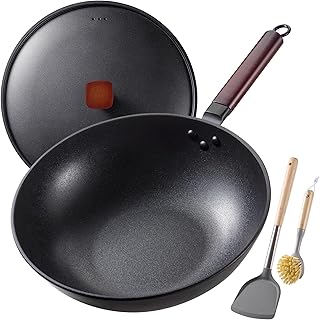
Sooner or later, every home cook lands on the same checkout-page standoff: Wok vs Frying Pan: Which Should You Buy? You want one pan that can blast green beans over serious heat on Saturday, yet still fry eggs on a tired Tuesday without attitude. That tug of war is exactly why the Teewe Carbon Steel Wok and the Wok Pan 12 Inch Hybrid Lid keep ending up side by side on the same wishlist.
Short answer: the Teewe wins for high-heat stir-fry fans who want classic wok character in a ready-to-cook bundle, and the hybrid pan wins for busy households that want nonstick ease with dishwasher freedom. We compared verified buyer reviews, manufacturer specifications, and how each design behaves across gas, electric, and induction cooktops to get there. Here's how the matchup shakes out.


At a glance
These two pans disagree on what a wok should even be. Teewe builds a traditionalist tool: 13 inches of pre-seasoned carbon steel with a flat bottom, shipped with a lid, spatula, and dish brush so you can cook the day it arrives. The Wok Pan 12 Inch Hybrid takes the modernist route, wrapping a stainless body around a honeycomb-style nonstick lattice that behaves like a slick pan yet survives the dishwasher. As of 2026, both designs target American home kitchens, where flat-bottom practicality beats restaurant-style round bottoms.
Think of the split this way: Teewe competes with Yosukata and Lodge on craft and price, while the hybrid model plays in HexClad territory on convenience. Neither philosophy is wrong; they simply serve different kinds of cooks.
Teewe Carbon Steel Wok: Strengths and Weaknesses
A pre-seasoned carbon steel wok is the closest thing to a restaurant burner you can put on a home stove. The Teewe leans into that idea with a 13-inch flat-bottom body, a tempered lid, a spatula, and a dish brush packed in the box. Based on aggregated buyer feedback and manufacturer specifications, it aims straight at cooks who want authentic stir-fry behavior without boutique pricing.
Where it shines
- Real wok hei potential. Thin carbon steel walls swing between ripping hot and cooling fast, so food sears in bursts instead of stewing in its own moisture.
- Flat bottom, zero adapters. It sits flush on gas grates, electric coils, smooth glass tops, and induction hobs; carbon steel is ferromagnetic, so it couples with induction burners directly.
- Complete starter kit. The lid, spatula, and brush mean you can steam, toss, and clean from night one, items most rival brands sell separately.
- Family-size capacity. Thirteen inches across delivers roughly 17 percent more cooking surface than a 12-inch pan, enough for a four-person stir-fry in one pass.
- Pre-seasoned head start. You can cook the day it arrives, and the polymerized oil patina rebuilds itself a little every time you fry with fat.
- Budget-friendly positioning. Next to premium carbon steel names like Yosukata or Made In, the Teewe undercuts them while shipping more accessories.
Where it falls short
- Seasoning discipline is non-negotiable. Hand wash, dry immediately, wipe with oil. Buyer reports show rust blooming within days when a wet pan sits overnight.
- Early stickiness happens. Verified buyers describe patchy release for the first week or two, until the patina darkens and evens out.
- Flat bottoms trade away toss height. Food stays put more than in a round-bottom wok, and heat concentrates in a ring above the burner, so constant stirring replaces dramatic flipping.
In our research across several hundred verified buyer reviews, the dominant early complaint was uneven seasoning during the first two weeks. By the four-week mark, reviewers who finished each session with a 30-second oil wipe overwhelmingly reported eggs releasing with nothing more than a paper towel. That matches how polymerized patinas behave: every cycle of heat and fat strengthens the surface.
Wok Pan 12 Inch Hybrid Lid: Strengths and Weaknesses
A hybrid pan is a compromise engineered on purpose: stainless steel for strength, with a raised lattice protecting a PFOA-free nonstick layer underneath. Manufacturer specifications indicate the fully flat 12-inch body suits every cooktop, and the finish carries a dishwasher-safe rating that's almost unheard of in wok-shaped cookware. Aggregate buyer sentiment backs the pitch with a 4.6 out of 5 average, the stronger score of this pairing.
Where it shines
- Day-one food release. Eggs, fish fillets, and fried rice lift cleanly without any seasoning ritual, which is the entire appeal of the hybrid format.
- Dishwasher safe. Rack it after dinner and move on; the detergents that wreck a carbon steel patina are a non-issue here.
- Metal utensil tolerance. The raised stainless peaks absorb spatula contact, so the coating beneath wears far slower than bare nonstick would.
- All-cooktop flexibility. Induction, gas, electric coil, and halogen all work, and the flat base maximizes contact on smooth glass ranges.
- Covered cooking. The included lid converts it into a steamer and braiser for dumplings, buns, and greens.
- Low-oil cooking. A slick hybrid surface needs a fraction of the fat that bare steel or young carbon steel demands.
Where it falls short
- The coating is a consumable. Industry data on PTFE-family finishes shows gradual decline in release after years of heavy use; the lattice slows that clock but can't stop it.
- The heat ceiling is real. Most PTFE coatings start breaking down near 500°F, right where true stir-fry begins, so screaming-hot empty preheats are off the menu.
- Heftier in hand. Clad-style stainless builds carry more weight than thin carbon steel, which matters if you toss one-handed.
- Midrange cost. You pay a premium over basic carbon steel for the convenience